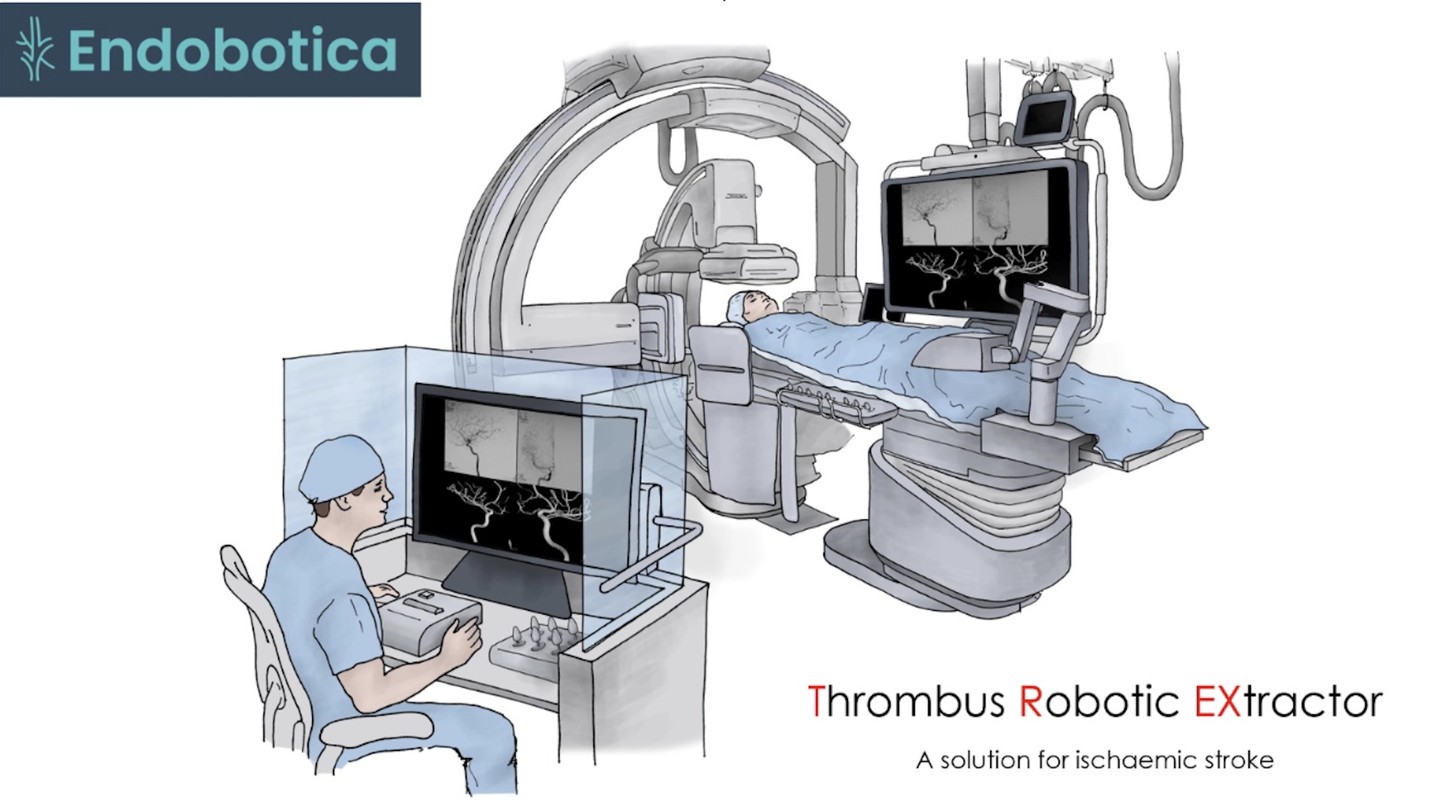
A spin-off from the REHAssist group has received a FIT-Innogrant to validate TREX, a teleoperated robotic system designed to make clot removal after ischaemic stroke faster, safer and more precise.
In an ischaemic stroke, the type caused by a clot blocking an artery in the brain, every minute counts. Standard treatment involves threading a catheter through the patient's vasculature up to the brain to extract the clot blocking an artery, a delicate manual procedure known as mechanical thrombectomy. Endobotica, a spin-off venture from the Rehabilitation and Assistive Robotics group (REHAssist) at the EPFL Neuro X Institute, is developing a robotic system to assist surgeons during the intervention, improving safety and effectiveness.
The company's first solution, TREX, is a teleoperated robotic platform that helps the physician locate the thrombus and restore blood flow more safely and efficiently. The CHF 100,000 FIT-Innogrant, awarded by the Fondation pour l'Innovation Technologique, will support Evgenia Roussinova, project lead and envisioned CEO of Endobotica, in validating the first prototype in challenging in vitro cases and refining the design with future users in mind, ahead of the next major step: in vivo validation.
The project grows out of a collaboration between REHAssist and the team of Professor Paolo Machi at the Geneva University Hospitals (HUG), supported by the Swiss National Science Foundation.
"Robotic mechanical thrombectomy for the treatment of acute ischaemic stroke represents a promising approach to making the intervention safer and more effective," says Dr Mohamed Bouri, who leads REHAssist. "Roussinova’s project is a natural continuation of our SNSF collaborative work with Professor Paolo Machi's team at the HUG. It aims to take this concept a step further by integrating AI-driven approaches that account for blood clot characteristics, with the goal of optimising both the clot penetration and extraction phases. I strongly believe that empowering robotics with embodied AI will make interventions case specific and minimise post-operative complications."
Endobotica is one of five Vaud-based projects to receive CHF 100,000 in this FIT round, and one of two from EPFL.